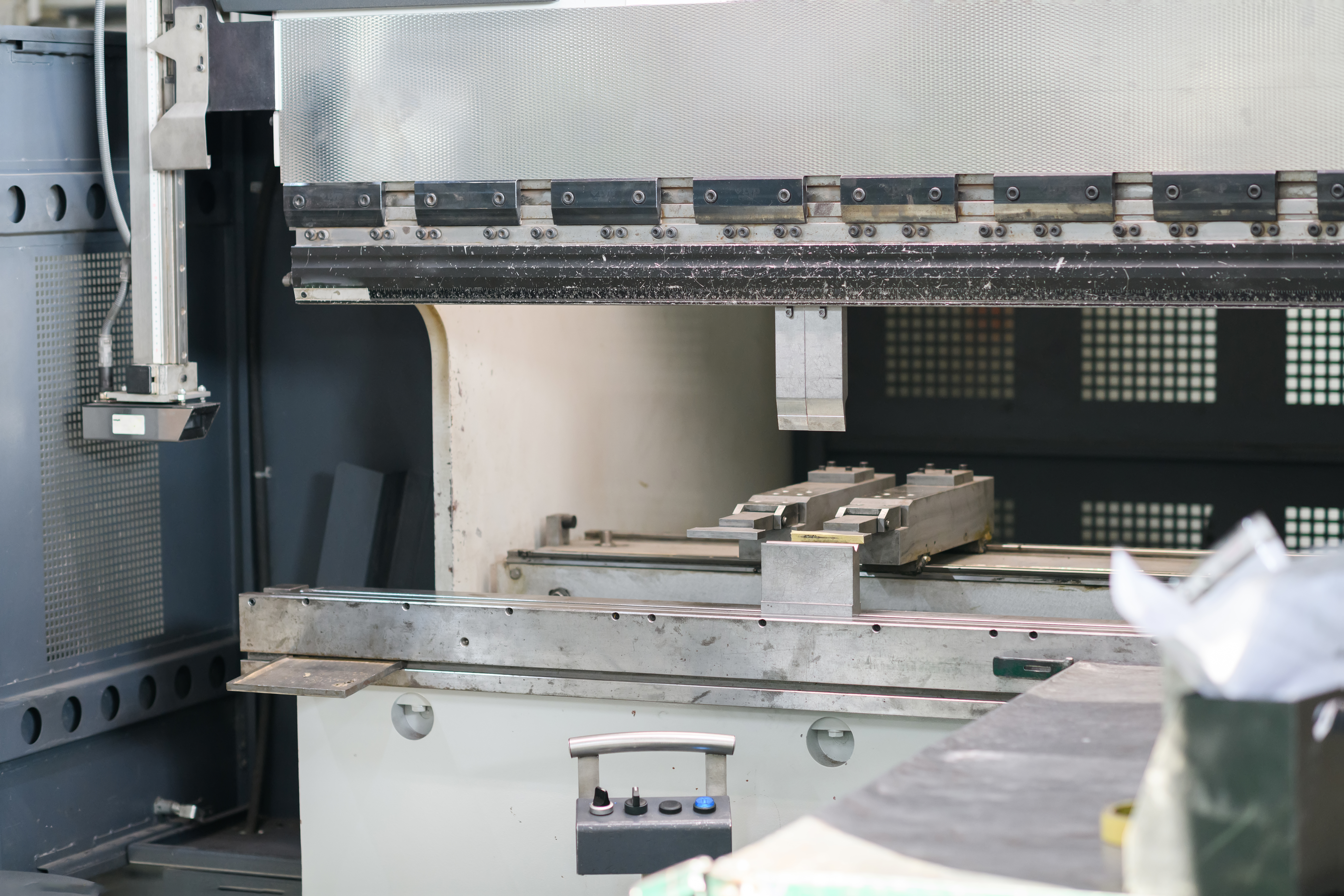
Press brake tonnage determines whether you can make a bend without bottoming out the machine or damaging tooling. This guide covers tonnage calculations for air bending, bottoming, and coining, plus the factors that affect required force.
Air Bending Tonnage Formula
For air bending (most common):
Tons = (L × T² × S) / (V × K)
Where:
- L = Bend length (feet)
- T = Material thickness (inches)
- S = Tensile strength (psi)
- V = Die opening (inches)
- K = Constant (typically 1.2)
Simplified for mild steel (60,000 psi tensile):
Tons/foot = (T² × 60,000) / (V × 1.2)
Quick Reference Chart
Tonnage per foot for mild steel (air bending):
| Thickness | V = 6×T | V = 8×T |
|---|---|---|
| 16 ga (0.060") | 3.0 | 2.3 |
| 14 ga (0.075") | 4.7 | 3.5 |
| 12 ga (0.105") | 9.2 | 6.9 |
| 10 ga (0.135") | 15.2 | 11.4 |
| 3/16" | 29.3 | 22.0 |
| 1/4" | 52.1 | 39.1 |
| 3/8" | 117.2 | 87.9 |
| 1/2" | 208.3 | 156.3 |
Calculate Bend Tonnage and Allowance
Get required tonnage, die selection, and bend allowance for your sheet metal job.
Material Factors
Multiply mild steel values by these factors:
- Aluminum: 0.5
- Stainless steel: 1.5-1.7
- High-strength steel: 1.5-2.0
- Spring steel: 2.0-2.5
Die Opening Selection
The die V-opening affects both tonnage and inside radius:
- V = 6×T: Smaller radius, higher tonnage, better control
- V = 8×T: General purpose, good balance
- V = 10×T: Lower tonnage, larger radius, less machine stress
Resulting inside radius ≈ V/6 for air bending.
Bottoming and Coining
Bottoming
Material is pressed to contact the die bottom. Requires 3-5× air bending tonnage but gives more consistent angles.
Coining
Material is compressed between punch and die. Requires 5-10× air bending tonnage. Used for tight radii and precise angles.
Most shops use air bending unless specifications require tighter tolerances.
Tonnage Distribution
Center your load on the bed:
- Short parts should be centered, not at one end
- Off-center loads cause uneven ram deflection
- Machine rated for total tonnage, but distributed evenly
Concentrated loads can damage the ram even if total tonnage is within rating.
Common Mistakes
- Ignoring material strength: Stainless needs much more tonnage than mild steel
- Wrong die opening: Too narrow causes over-tonnage; too wide gives poor results
- Not accounting for length: Multiply per-foot values by actual bend length
- Forgetting flange interference: U-channels and boxes may need special tooling
Machine Selection
When sizing a press brake:
- Calculate worst-case tonnage requirement
- Add 20-30% safety margin
- Consider bed length for part length plus tooling
- Stroke length for die height and box depths
Accurate tonnage calculation prevents machine damage, tooling breakage, and wasted material. When in doubt, use a wider die opening to reduce tonnage requirements—the slightly larger radius is usually acceptable.