Accurate bend allowance calculations are essential for sheet metal fabrication. Get it wrong, and your flat pattern won't fold into the intended dimensions. This guide covers bend allowance, bend deduction, K-factor, and how to calculate flat patterns for precision parts.
What Is Bend Allowance?
When sheet metal bends, the outer surface stretches while the inner surface compresses. Somewhere between these surfaces is a neutral axis that neither stretches nor compresses. Bend allowance is the arc length of this neutral axis through the bend.
In practical terms, bend allowance tells you how much material you need to add to your flat pattern to account for each bend.
The Bend Allowance Formula
The standard formula is:
BA = A × (π/180) × (R + K × T)
Where:
- BA = Bend Allowance
- A = Bend Angle in degrees
- R = Inside Bend Radius
- T = Material Thickness
- K = K-Factor (position of neutral axis)
Example Calculation
For a 90° bend in 0.060" aluminum with 0.125" inside radius and K-factor of 0.33:
BA = 90 × (π/180) × (0.125 + 0.33 × 0.060)
BA = 1.571 × (0.125 + 0.020)
BA = 1.571 × 0.145 = 0.228"
Calculate Bend Allowance Instantly
Get bend allowance, bend deduction, and flat pattern length. Supports all bend angles and K-factors.
Understanding K-Factor
The K-factor represents the position of the neutral axis as a ratio of material thickness. It ranges from 0 (neutral axis at inside surface) to 1 (neutral axis at outside surface), with most values between 0.3 and 0.5.
Factors Affecting K-Factor
- Bend radius: Tighter radius = lower K-factor
- Material type: Softer materials = higher K-factor
- Material thickness: Thicker material = slightly higher K-factor
- Bend method: Air bending vs. bottoming vs. coining
Common K-Factor Values
| Material | Air Bending | Bottoming |
|---|---|---|
| Soft Aluminum | 0.33 | 0.42 |
| Mild Steel | 0.33 | 0.40 |
| Stainless Steel | 0.33 | 0.38 |
| Copper | 0.35 | 0.44 |
Pro tip: When in doubt, start with K = 0.33 for air bending. Refine based on test bends with your specific material and tooling.
Bend Deduction Method
Many fabricators prefer using bend deduction (also called setback or outside setback). This tells you how much to subtract from the sum of your outside dimensions:
BD = 2 × OSSB - BA
Where OSSB (outside setback) is:
OSSB = tan(A/2) × (R + T)
For a 90° bend, this simplifies to: OSSB = R + T
Calculating Flat Pattern Length
For a simple two-flange part:
Flat Length = Leg1 + Leg2 + BA
Or using the deduction method:
Flat Length = (Leg1 + R + T) + (Leg2 + R + T) - BD
Flat Length = Outside Dimension 1 + Outside Dimension 2 - BD
Minimum Bend Radius
Every material has a minimum inside bend radius before cracking. General guidelines:
- Soft aluminum: R = 0 to 0.5T
- Mild steel: R = 0.5T to 1T
- Stainless steel: R = 1T to 2T
- Spring steel: R = 2T to 4T
Bending perpendicular to the grain allows tighter radii than bending with the grain.
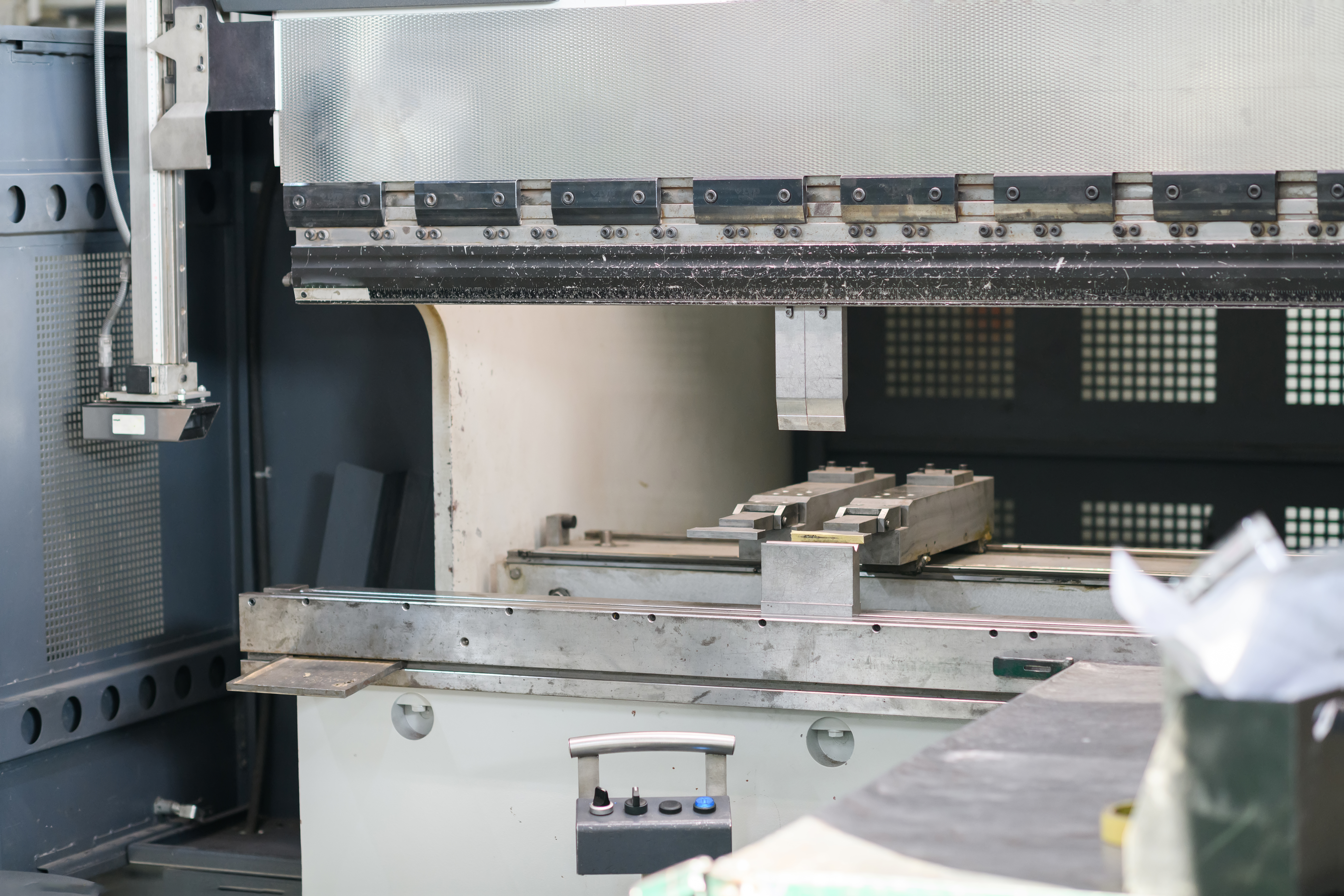
Press Brake Die Selection
Die width affects the resulting inside radius. The rule of thumb:
Inside Radius ≈ Die Width / 6 (for air bending)
Standard die widths are typically 6× to 8× the material thickness. Using a wider die reduces tonnage requirements but gives a larger radius.
Common Mistakes
- Ignoring K-factor variation: Different materials and bend methods need different K-factors
- Measuring inconsistently: Always specify whether dimensions are to inside, outside, or centerline
- Forgetting springback: Material springs back after bending; overbend to compensate
- Not testing: Always verify calculations with test pieces before production
Shop Tips
- Keep a bend deduction chart for your specific materials and tooling
- Measure actual inside radius after bending—it's rarely exactly what you calculated
- Account for burr direction when placing parts in the brake
- For critical parts, make test bends and measure; adjust calculations accordingly
Mastering bend calculations takes practice and material-specific experience. Start with standard K-factors, verify with test bends, and refine your values over time. A shop's bend tables, developed from actual results, are worth more than any theoretical calculation.