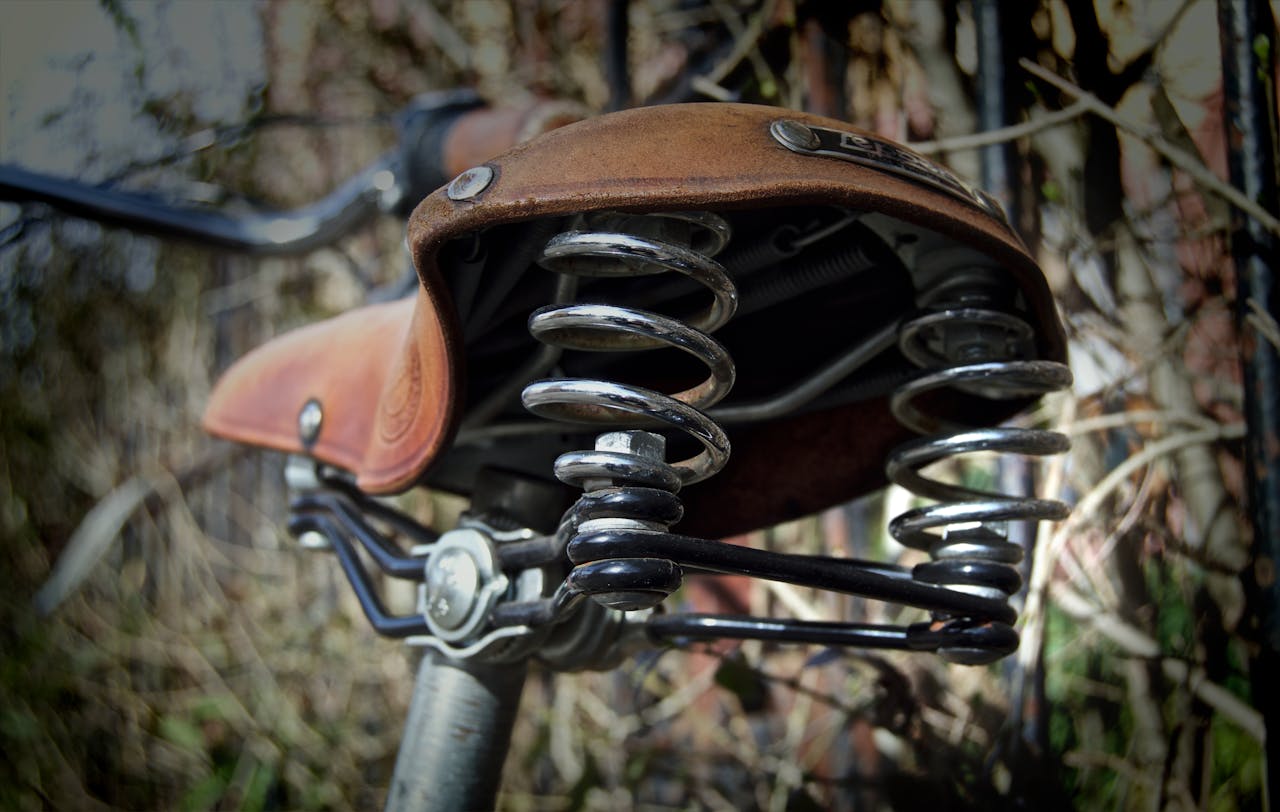
Springs store and release energy through elastic deformation. Spring rate (spring constant) determines how much force is required for a given deflection. Understanding spring calculations helps you select the right spring or design custom ones.
Spring Rate Basics
Spring rate (k) is expressed in force per unit deflection:
k = F / δ
Where F is force and δ is deflection. Units are lb/in or N/mm.
A spring with k = 10 lb/in requires 10 pounds to compress it one inch, 20 pounds for two inches, and so on (within the linear range).
Compression Spring Formula
The spring rate for a helical compression spring:
k = Gd⁴ / (8D³n)
Where:
- G = Shear modulus (11.5×10⁶ psi for music wire)
- d = Wire diameter
- D = Mean coil diameter
- n = Number of active coils
Notice that wire diameter has the most influence (d⁴)—doubling wire diameter increases rate 16×.
Calculate Spring Rate and Force
Enter spring dimensions to get rate, force at deflection, stress, and operating limits.
Example Calculation
A spring with:
- Wire diameter: 0.072"
- Mean diameter: 0.625"
- Active coils: 8
k = (11.5×10⁶ × 0.072⁴) / (8 × 0.625³ × 8)
k = (11.5×10⁶ × 0.0000269) / (8 × 0.244 × 8)
k = 309 / 15.6 = 19.8 lb/in
Spring Index
Spring index (C = D/d) affects manufacturability and stress:
- C < 4: Difficult to coil, high stress concentration
- C = 6-10: Optimal range
- C > 12: Prone to tangling, may buckle
Stress in Springs
Shear stress in the wire:
τ = 8FD / (πd³) × K_w
K_w is the Wahl correction factor accounting for curvature and direct shear. For design, keep stress below ~60% of the wire's tensile strength.
Extension Springs
Extension springs use the same rate formula but have initial tension—force required before the spring starts to extend:
- Initial tension typically 10-30% of the spring's maximum force
- Hooks add stress concentrations—they're often the failure point
Springs in Series and Parallel
Series (End to End)
1/k_total = 1/k₁ + 1/k₂
Result is softer than either individual spring.
Parallel (Side by Side)
k_total = k₁ + k₂
Result is stiffer than either individual spring.
Common Spring Materials
| Material | G (×10⁶ psi) | Use Case |
|---|---|---|
| Music Wire | 11.5 | General purpose, high strength |
| Oil Tempered | 11.2 | Larger sizes, lower cost |
| Stainless 302 | 10.0 | Corrosion resistance |
| Phosphor Bronze | 6.0 | Electrical, corrosion |
Design Considerations
- Solid height: Spring coils touch; don't operate past this point
- Buckling: Free length > 4× diameter may buckle under compression
- Fatigue: Cyclic applications need lower stress levels
- Ends: Closed and ground ends reduce solid height and improve squareness
Selecting Standard Springs
When possible, use catalog springs rather than custom:
- Lower cost due to volume manufacturing
- Immediate availability
- Tested and characterized specifications
Custom springs make sense for high volumes or when standard sizes don't meet requirements.
Spring design balances rate, stress, fatigue life, and space constraints. Start with the required force and deflection, work backward to spring dimensions, then verify stress levels are acceptable.